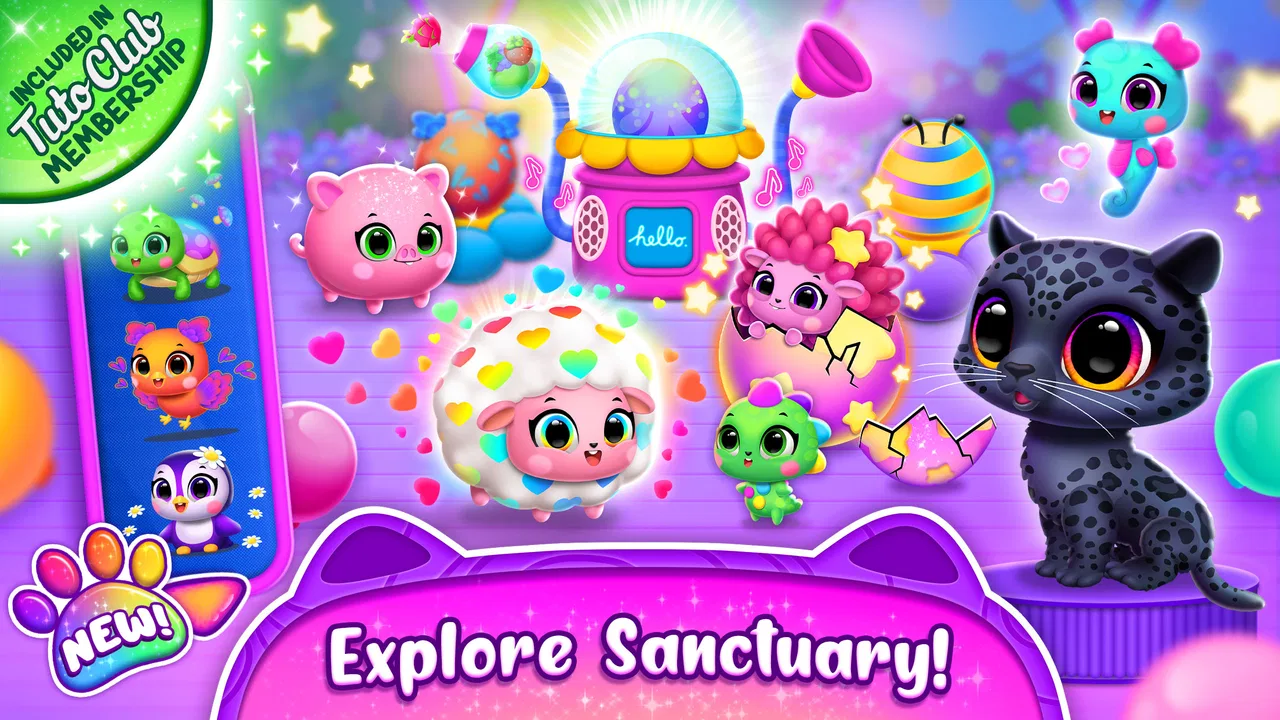
Jungle Floof - Island Pet Care
- 3.9
- Rating
- 10.00M
- Installs
- Free
- Price

 Analysis by App-foxy
I spent time with Jungle Floof - Island Pet Care as a light, child-friendly animal game, and my first impression was clear: it is designed around caring for virtual jungle animals rather than winning difficult challenges. You meet the creatures, look after their needs, and use simple activities to keep the experience moving. That makes it easy to understand within minutes, especially for younger players who may not be ready for complicated controls or competitive gameplay.
The game comes from TutoTOONS and sits in the educational category. It is free to start, carries an Everyone age rating, and works on devices running Android 6.0 or later. Its broad audience is reflected in its reach, with more than ten million installs and an average rating of 4.0 from around ten thousand ratings. Those figures suggest a familiar pattern for this kind of title: many families find the format approachable, while the experience may not satisfy players looking for deep progression or demanding strategy.
How the everyday care loop feels
My usual session begins by checking what the animals need and then moving through the available care activities one at a time. The important thing is not speed. The game works best when I treat it as a short routine: open the island, see which animal needs attention, complete the relevant interaction, and then decide whether I want to continue or stop. That rhythm makes it suitable for a few quiet minutes rather than a long, uninterrupted gaming session.
You May Also Like

 Blood Strike: 2.5 Anniversary
Blood Strike’s Loadouts Turn Every Drop Into a Tactical Gamble
A close look at Blood Strike’s custom loadouts: how fast access to signature weapons reshapes its battle royale rhythm, rewards preparation, and narrows the gap between fights.

 Pandora - Music & Podcasts
Pandora’s Music Is Easy to Start, but Harder to Recover
Pandora’s strength is its low-effort path from a seed to a station. Its weak spot is how much confidence it asks you to place in connection, setup, and quiet recovery.

 8 Ball Pool
 Is Built on Rivalries, Rematches, and Routine
A close look at the rivalries, rematches, shared routines, and unanswered safety questions that turn a quick pool match into a persistent mobile community.

 Samsung Music
’s Quiet Strength Is Playing What You Already Own
Its reach comes less from spectacle than from dependable access to a personal library. That simplicity is both the app’s strongest retention engine and its ceiling.

 AccuWeather: Weather Radar
AccuWeather Review: A Quick, Clear Forecast for Everyday Decisions
For everyday plans, the best forecast is the one you can understand quickly. AccuWeather makes rain timing, radar, and local conditions easy to act on, with a few trade-offs.

 Hill Climb Racing
Why Hill Climb Racing Still Turns Crashes Into One More Run
A tiny car, a bumpy hill and one more upgrade: Hill Climb Racing keeps resurfacing because its simple chaos makes every near-miss feel personal.
More From Our News Desk



The animal-care theme gives children an immediate reason to explore. Instead of presenting abstract menus or a complicated map, the game frames progress through familiar actions such as looking after creatures and spending time with them. I found that this makes it easier for a child and an adult to play together. A parent can ask what an animal needs next, while the child remains responsible for choosing and performing the interaction.
One useful habit is to avoid tapping through everything as quickly as possible. Younger players get more from the game when they pause to identify the animal, observe the available choices, and explain why a particular care action makes sense. That turns a simple play session into a small exercise in sequencing and attention. It is not a replacement for a structured learning app, but it can encourage a child to follow a routine and notice changing needs.
The game is also forgiving in the way a casual family title should be. I never felt that a short session had to become a serious commitment. If I stopped after caring for one animal, I could return later without needing to remember a complicated strategy. That makes it a practical choice for travel, waiting rooms, or a brief wind-down before bedtime, provided the child is using a device with suitable parental supervision.
For a realistic everyday example, imagine a child finishing breakfast before school and asking for a quick game. I would use this title as a ten-minute activity: choose an animal, complete a care task, talk through what happened, and close the app rather than letting the session drift. The game’s simple structure supports that boundary better than many open-ended games, although adults still need to manage screen time because the free entry point can make it tempting to continue.
What to check before handing over the device
Because the game is free to download, I would not treat the initial installation as the whole decision. The experience includes in-app purchases ranging from $1.49 to $159.99 per item. That is the most important practical detail for families. I recommend checking the device’s purchase protections before a child plays independently, and I would make sure the child understands that an on-screen option is not automatically something they should buy.
I also pay attention to how the child reacts to repeated prompts or optional spending opportunities. Some children can ignore them easily; others focus on anything that appears to unlock more content. In the second case, I would keep play supervised or use the device’s family controls. This is not a criticism of the animal-care concept itself, but it does affect whether the game feels comfortable as an unsupervised activity.
The Everyone rating makes the game broadly suitable from an age-classification perspective, but that does not mean every child will enjoy it equally. A preschooler may need help understanding what to do, while an older child might find the interactions too gentle after the novelty fades. I would judge suitability by the child’s patience and interest in pretend care, not only by the rating label.
The current version is 6.0.158. I would keep the app updated through the normal store process so that the installed build matches the current release available for the device. On older phones or tablets, I would also leave enough free storage and close other demanding apps before play. The minimum operating-system requirement is Android 6.0, so compatibility is fairly broad, but operating-system support alone does not guarantee that every older device will feel equally responsive.
Settings and household routines that make it easier
There are no complicated control schemes to master, which is one of the game’s strengths. My useful “settings” routine is therefore mostly about the device around the game: I check sound before opening it in a quiet place, set a session limit when a child is playing, and confirm that purchases require adult approval. These small steps matter more here than searching for advanced gameplay controls that are not central to the experience.
Sound can change the feel of a care game considerably. In a shared room, I prefer a lower volume or headphones used only when appropriate. In a parent-and-child session, keeping sound audible can help the adult notice when the child is moving into another activity or becoming frustrated. The game is easier to discuss when it is treated as a shared screen rather than an isolated distraction.
I also recommend creating a repeatable starting question: “Which animal needs us first?” It gives the child a simple goal without turning the session into an instruction-heavy lesson. After the care action, I ask what changed and whether another animal should be checked. This approach helps the child build a predictable workflow while preserving the playful tone.
Another practical adjustment is to decide in advance whether the game is being used for independent play or co-play. During independent play, I would keep the session shorter and make the purchase rules explicit. During co-play, I would let the child lead while I help with reading, navigation, or interpreting an unfamiliar prompt. The same game feels very different depending on this arrangement, and choosing deliberately prevents it from becoming background screen time.
Faster patterns for experienced players
Once the basic loop is familiar, the fastest approach is not frantic tapping. It is a consistent scan. I begin with the animal currently asking for attention, complete that interaction, and then look for the next clear task instead of opening every possible option. This reduces wandering and makes a short session feel complete.
I have found that children often move more efficiently when they are given one decision at a time. Asking them to manage the whole island can create unnecessary confusion, especially if several animals or activities are visible. A better pattern is: identify one need, finish it, describe the result, and choose the next step. This is both faster and more educational than taking control of the device and doing everything for them.
For adults, the useful shortcut is preparation. Before handing over the phone, I make sure the device is charged, the volume is appropriate, and purchase protection is active. That prevents the most common interruptions. I also decide where the session should end, such as after caring for a particular animal or completing one short round of activities. The game itself stays simple, but the surrounding routine determines whether it feels calm or chaotic.
Another effective pattern is to use the game as a transition rather than a reward that has no endpoint. For example, a child might play briefly after putting away toys, then close the app before another household activity begins. The care loop is well suited to this because it has natural moments to pause. I would not promise that every child will stop willingly, but the structure gives an adult a clearer stopping point than a game built around endless competitive matches.
It also helps to rotate who makes the decisions. On one session, the child can choose which animal to visit first. On another, the adult can ask the child to explain the order of care. This keeps the familiar interactions from becoming automatic tapping. The game remains accessible, but the conversation around it adds variety without pretending that it contains a full lesson plan.
Where the educational value is real—and where it stops
I see the educational value mainly in routine, observation, vocabulary, and simple cause-and-effect thinking. A child can practice identifying animals, remembering what happened in the previous interaction, and following a small sequence of tasks. Those are worthwhile skills, especially when an adult talks through the choices.
However, I would not choose it as a primary tool for reading, mathematics, science instruction, or formal animal education. The game’s strength is experiential pretend care, not a structured curriculum. If your goal is measured practice, lessons, or clearly staged academic progress, a dedicated educational app will be a better match. This title works more naturally as a playful supplement.
Compared with a traditional virtual-pet game, the jungle setting gives the experience a more exploratory identity and an animal-focused atmosphere. Compared with a puzzle-heavy educational game, it asks less of the player intellectually and offers a gentler pace. Compared with a video, it gives the child something to do rather than only something to watch. The trade-off is that the interaction may feel repetitive to children who want constant novelty or increasingly difficult challenges.
Limits that become clearer over longer sessions
The biggest limitation is depth. After the initial appeal of meeting and caring for the animals, experienced players may want more complex goals, stronger customization, or a clearer long-term challenge. I would not recommend it to someone searching for a strategy game, a detailed simulation, or a competitive title. Its simplicity is intentional, but simplicity can become repetition when the player is older or already familiar with similar pet games.
The free-to-start model is another point to weigh carefully. The purchase range means the game should be introduced with clear household rules, particularly on a child’s personal device. If you dislike games that mix free access with optional paid items, this may not be the most comfortable choice even if the animal-care gameplay itself appeals to you.
There is also a difference between playing alone and playing with guidance. A child who cannot read comfortably may need an adult nearby, depending on the interaction. An older child may manage independently but lose interest sooner. I would therefore avoid labeling it as universally self-directed. It is easiest for early players when an adult demonstrates the first routine and then gradually steps back.
Finally, the four-point average rating indicates a generally positive reception without suggesting universal enthusiasm. I read that as a fair warning to keep expectations realistic. The game can be charming and useful in short bursts, but it is not trying to be an expansive adventure. Its best audience is narrower than its Everyone rating: children who enjoy nurturing animals and families who appreciate calm, uncomplicated play.
My verdict after settling into the routine
I recommend Jungle Floof - Island Pet Care for families looking for a gentle animal game that can support short, supervised play sessions. TutoTOONS has focused on an approachable care loop, and that focus makes the game easy to introduce. I especially like it as a shared activity where a child makes the choices and an adult encourages observation instead of taking over.
The best way to use it is as a small repeatable routine, not an endless game. Check the animals, complete one or two care activities, talk about the choices, and stop at a clear natural break. That method brings out the game’s strongest qualities while reducing the risk of aimless tapping or an unexpectedly long session.
I would skip it if you want advanced progression, demanding puzzles, a serious simulation, or a fully curriculum-based learning tool. I would also think twice if optional purchases are a deal-breaker in children’s games. In those situations, a paid educational title with a fixed structure or a deeper pet simulator may suit you better.
For everyone else, the free entry point makes it easy to try, and the Everyone rating broadens its family appeal. Just remember that the optional items can cost from $1.49 up to $159.99 each, so device-level purchase controls are essential. With that precaution, I see it as a pleasant choice for quiet co-play, quick transitions, and children who enjoy the feeling of looking after virtual jungle animals.
My final view is positive but measured. Jungle Floof - Island Pet Care succeeds when it stays in its lane: friendly animal interactions, simple care, and low-pressure play. It does not need complicated systems to serve that purpose. If your child wants a calm digital pet routine and you are willing to guide the first sessions and set sensible boundaries, it is worth trying.
FAQs for Jungle Floof - Island Pet Care
01What is the main objective of Jungle Floof - Island Pet Care?
Jungle Floof - Island Pet Care is a virtual pet simulation game where players nurture and care for adorable creatures on a tropical island. The primary objective is to ensure the well-being of your pets by feeding, grooming, and playing with them, while also expanding and customizing your island habitat.
02Is Jungle Floof suitable for children?
Yes, Jungle Floof is designed to be family-friendly and suitable for children. It features colorful graphics, simple controls, and engaging gameplay that encourages creativity and responsibility. However, parental guidance is recommended due to potential in-app purchases and online interactions.
03Does Jungle Floof require an internet connection?
While Jungle Floof can be played offline, certain features like social interactions, events, and in-app purchases require an internet connection. Playing online enhances the experience by allowing players to connect with friends and participate in global challenges.
04Are there in-app purchases in Jungle Floof?
Yes, Jungle Floof offers in-app purchases for items like premium currency, exclusive pets, and decorative items. These purchases enhance gameplay but are not necessary to enjoy the full experience. Players can progress through the game without spending money by completing tasks and earning rewards.
05How customizable is the island in Jungle Floof?
The island in Jungle Floof is highly customizable, allowing players to personalize their environment with a variety of plants, structures, and decorations. As players progress, they unlock new items and features, enabling them to create a unique and vibrant habitat for their pets.
Pros
- Engaging pet care mechanics.
- Vibrant and colorful graphics.
- Variety of mini-games included.
- Regular updates with new content.
- User-friendly interface.
Cons
- In-app purchases can be pricey.
- Occasional ad interruptions.
- Requires constant internet connection.
- Limited customization options.
- Some features locked behind paywall.

Jungle Floof - Island Pet Care
Gallery